Farid-Ahmed Badar
Scientific/Research Director , BioMolecular Science Gateway
Location: Henry Ford Hospital
Email: badarfar@msu.edu
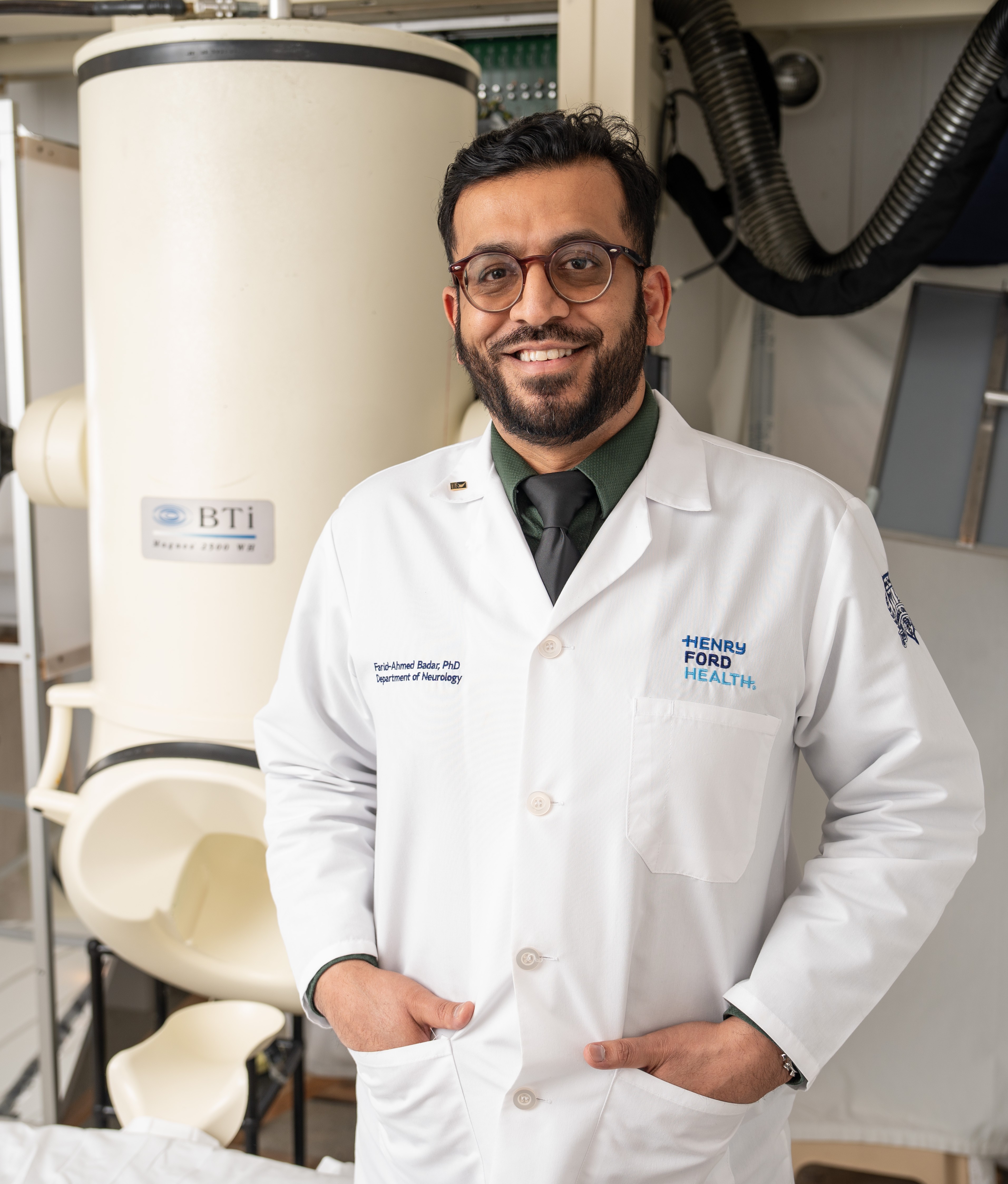
Bio
My research focuses on the use of magnetoencephalography (MEG) to study brain function and dysfunction, with a particular emphasis on epilepsy and other neurological disorders. MEG is a non-invasive neuroimaging technique that captures the magnetic fields generated by neural activity, offering millisecond-level temporal resolution and excellent spatial localization when combined with anatomical MRI.

At Henry Ford Health’s Department of Neurology, I support and lead research and clinical initiatives aimed at improving functional brain mapping and seizure localization. MEG plays a critical role in the presurgical evaluation of patients with drug-resistant epilepsy, helping to identify the seizure onset zone and essential cortical areas involved in language and motor function. I work closely with neurologists, neurosurgeons, and radiologists to integrate MEG data into clinical decision-making workflows.

In parallel, I am building a research program that explores how MEG can be used to study abnormal neural oscillations, functional connectivity, and brain network dynamics in epilepsy and other disorders such as tumors, traumatic brain injury, and neurodegenerative diseases. My interests include improving MEG signal processing, enhancing source localization techniques, and integrating MEG with structural and functional MRI to create more comprehensive models of brain function.

Future directions of my work include applying machine learning and advanced statistical methods to MEG data for predictive modeling, exploring resting-state and task-based paradigms to characterize patient-specific brain networks, and developing open-source pipelines to increase the reproducibility and clinical utility of MEG analyses.

This research is well-suited for graduate students interested in neuroimaging, computational neuroscience, clinical neurophysiology, or biomedical engineering. Students will gain experience in processing high-resolution MEG data, working with clinical patient datasets, and contributing to translational neuroscience projects with real-world impact.